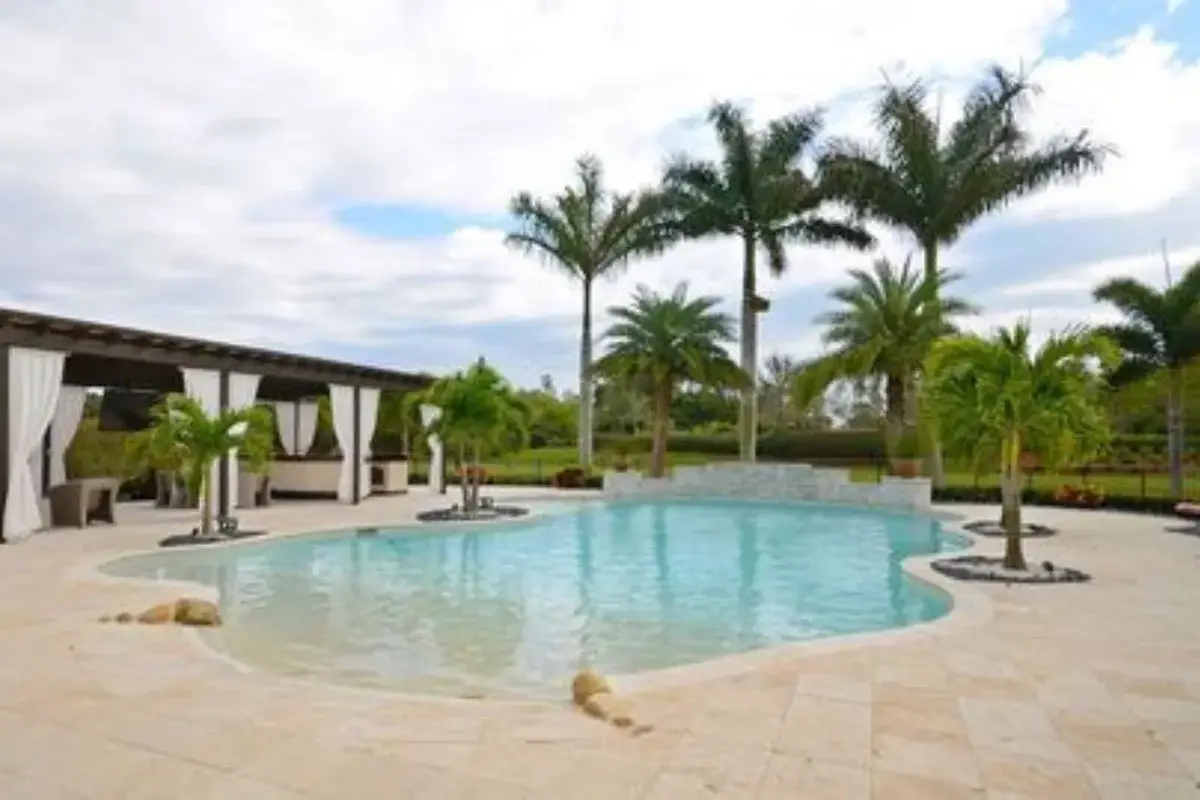
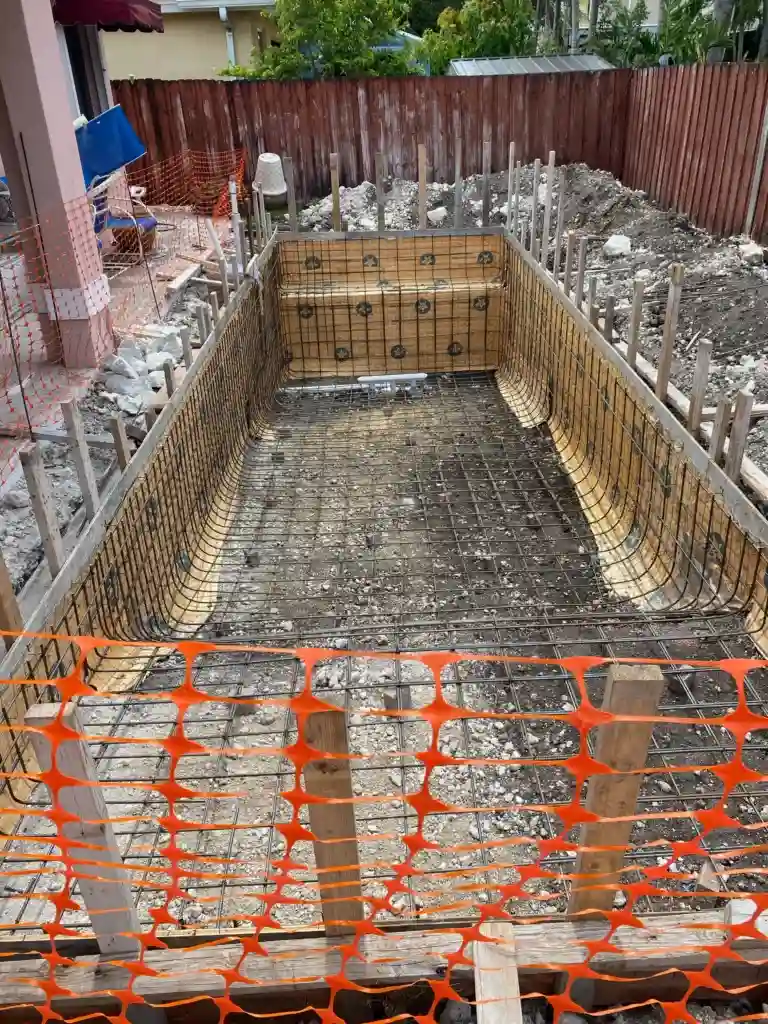
Two houses on the same street in Dacula can want the same pool and get two different builds. From the road the lots look identical. Three feet down they are not. Building a pool on red clay soil in Georgia comes down to what is under the grass, how fast the yard falls, and where the county will not let you dig. After fifteen years building pools in Georgia from a base in Gwinnett County, the short version is this: the ground writes the first draft of every design.
Why two houses on one Dacula street carry different pool costs
One lot runs flat to the back fence with a wide side gate. The next drops six or eight feet to the property line, carries a drainage easement across the low corner, and shows rock in the neighbor’s driveway cut. Same pool on paper, completely different excavation, hauling, backfill and drainage, which is why we do not quote a pool off a satellite image.
Why building a pool on red clay soil in Georgia looks nothing like the build videos
Most pool build videos are filmed in sand, where crews spend their energy keeping the hole from caving in. Piedmont red clay is fine grained with almost no space between particles, so we get the opposite problem plus one they never face:
- It holds a vertical cut well, which helps when we shoot a concrete shell against it.
- It will not pass water. Rain that vanishes into sand in ten minutes sits on clay, runs sideways, or perches on the first hard layer.
Clay also swells wet and shrinks dry around whatever you bury in it, which is why backfill and drainage matter more here than in a sandy market. It is also where a cheap bid quietly saves money.
Excavation day: finding out what is really under your yard
A site read tells us plenty. The bucket tells the rest:
- Bright orange giving way to mottled tan and white, which means weathered parent rock.
- Mica glitter in the spoil, a granite signature meaning the ridge is closer than it looked.
- The bucket chattering instead of cutting. That is refusal, and it changes the day.
- How fast the pile grows. Clay bulks up when dug, and on a tight lot it goes on a truck.
Rock, saprolite and what a rock clause means for you
On the ridges around Dacula, Braselton and Hamilton Mill, granite and saprolite turn up within a few feet of grade. Saprolite is rotten rock, granite weathered in place but never moved. It crumbles in your hand and digs almost like dirt, until it does not.
Hard rock gets broken with a hydraulic hammer, slow and hard on equipment, so most contracts carry a rock clause. Ask any builder what counts as rock, how the extra work is measured, and when you get told before the meter runs.
Backfill and compaction: why a deck cracks in year five
Once the shell is shot and cured, the gap between concrete and earth wall gets filled back in. Clay dumped in one big lift bridges itself and leaves voids. It rains for a week, the voids collapse, and the deck settles a fraction of an inch. The concrete shell does not move. The deck does. They part company at the coping joint, and that is the hairline crack homeowners call about years later.
The fix is just work: thin lifts, compact each one, granular backfill against the shell instead of the wet clay that came out. Same logic for the patios and paver decking, where pavers on a compacted base ride small movement better than a slab on soft fill.
Water has to go somewhere, so drainage comes before digging
On the walk out basement lots on the Apalachee River side of Dacula and toward Little Mulberry Park, runoff comes fast off the roof, the upper yard and the neighbor’s grade, and clay takes none of it. Then we set a pool in that path, and a pool is a dam. Water stacks behind it, saturates the backfill, and finds the lowest door in the house, which on a walk out lot is a basement door. So drainage gets designed with the pool:
- A French drain, a gravel filled trench with a perforated pipe, catching water above the pool.
- A real outlet. Every drain has to daylight somewhere legal and downhill, which often decides where the pool sits.
- Downspouts piped away from the pool, and enough deck fall to shed water off the coping.
That work costs far more after the deck is poured, so it belongs in the pool budget.
Easements, stream buffers and ground you cannot build on
Before the soil gets a vote, the plat does. Gwinnett wants an approved swimming pool location plan showing the pool, decking, equipment, easements and buffers, and our companion post on permits and setbacks covers that paperwork.
Say a creek runs at the back of the lot. Gwinnett protects it with a 50 foot undisturbed county buffer measured from the top of the stream bank, which contains the 25 foot state waters buffer, with a 75 foot impervious setback beyond it. Read that as ground, not paperwork: the strip nearest the water is where clay stays wet longest and where everything uphill drains.
Easements do the same job quietly. A drainage or sewer easement is a lane somebody else can dig up, and around Dacula, Bethlehem and Winder it follows the low back corner where water already collects. On unsewered lots in Barrow and Jackson, the septic drainfield claims the best draining ground on the property. Between a buffer, an easement and a drainfield, the buildable pad is often smaller than the fence line suggests, so we lay the plat over the grade before drawing a shape. Ordinances change, so confirm current requirements with your county.
Sloped and walk out lots: when a retaining wall is structure
Around Dacula, Bethlehem, Winder, Auburn and out toward Bogart and Watkinsville, plenty of back yards have no flat pad until a wall makes one. That wall is not landscaping. It holds a hillside, often beside tens of thousands of pounds of water.
Height and the load behind it decide whether the design needs engineering. Drainage behind the wall matters more here than anywhere, because clay pushes when wet: clean gravel, filter fabric so clay does not choke it, and a pipe carrying water to daylight. Walls that lean years later failed at drainage, not at the block. Our retaining wall page covers how we build and repair them.
How the ground changes the design, not just the price
Slope is not a problem to be flattened. It is why the best pools here look the way they do: a raised beam, a spillover spa above the water, a vanishing edge pointed down the fall, a deck that steps in two levels instead of one slab fighting the hill.
What you can look at yourself this weekend
- In the next hard rain, watch where water runs and stands.
- Find your plat. Dashed lines near the property edges are usually easements.
- Eyeball the drop from your back door to the fence, and measure your side gate.
Related reading on hydrostatic pressure and empty pools
A pool already in the ground has the opposite clay problem: why a concrete pool can pop out of the ground when it is drained.
Get the ground read before you shop shapes
Weighing a pool on a clay lot, a rocky ridge or a walk out slope? Have the dirt read first. We walk the yard for grade, drainage and access, then turn it into a free 3D design you approve before work starts. See our new pool construction page or call Aqualis Pools at (770) 373-8405, Monday to Friday, 8AM to 5PM. We are at 3244 Hall Rd, Dacula, GA 30019.
Frequently asked questions
Does red clay automatically make a pool more expensive to build in Georgia?
No. Clay is workable and holds an excavation wall better than sand. Cost moves on what comes with it: rock or saprolite near the surface, spoil that has to be hauled, slope that needs a wall, and drainage work.
Do I need a retaining wall for a pool on a sloped or walk out basement lot?
Usually, if you want a usable flat deck. On a lot with real fall, the wall creates the pad the pool and decking sit on, and it is structural because it holds soil and water back. Drainage behind it keeps it standing.
Can I put a pool anywhere in my back yard in Gwinnett County?
No. Gwinnett requires an approved swimming pool location plan, keeps the pool, decking and pump equipment at least five feet off side and rear property lines, puts pools in the rear yard, and allows no encroachment into stream buffers or easements. Rules change, so confirm with your county.