You have decided on the pool, and the next thought is usually about red tape. Here is the honest version. A pool permit in Gwinnett County has to be issued before anyone disturbs a foot of your yard. You are not the one filing it. We pull the permit, draw the plan the county wants to see, and meet the inspector at every stage. After fifteen years building pools in Georgia from a base in Gwinnett County, this is routine for us and new to nearly every homeowner we meet.
The short answer: yes it needs a permit, and no, you are not filing it
Gwinnett requires a building permit before any land disturbance, installation or construction. Not after the hole is dug. Before the machine arrives. Barrow requires the same through its own department.
What counts as a pool to the county: 24 inches of water
Gwinnett defines a residential swimming pool as any structure intended for noncommercial swimming or recreational bathing that holds water more than 24 inches deep. That definition explicitly names inground, aboveground and onground pools, plus hot tubs and spas. So a hot tub or spillover spa deeper than two feet is in scope, not a weekend patio purchase.
On a septic lot, Environmental Health goes first, in Gwinnett as well as Barrow
People assume the septic step is a rural Barrow thing. It is not. If the home is on a private septic tank system, Gwinnett Environmental Health has to approve where the pool will sit before a permit can be issued at all, and proof of that approval is attached to the application.
Barrow handles it with a letter, required on septic and waived on public sewer. On the larger lots around Bethlehem and Winder, this step often decides where the pool can go.
The Swimming Pool Location Plan, and why we pull your plat first
Gwinnett wants a Swimming Pool Location Plan, approved by the Development Review Section. It has to be drawn to a measurable architect or engineer scale, for example 1 inch to 10 feet, though it does not have to be drawn by a surveyor or an engineer. It must show:
- The lot boundaries
- The existing house and the driveway
- Easements, streams and buffers
- The proposed pool with its protective barriers, decking and pumps
- Every distance labeled to the property lines
Those lot dimensions come off the Final Subdivision Plat, obtained from the Deed Records Office of the Clerk of Superior Court at 75 Langley Drive in Lawrenceville. That is a real errand, and why we pull the plat before the design is locked.
Where the county will and will not let the pool sit
- In the rear yard, behind the house
- At least five feet from any side or rear property line
- At least 10 feet between the edge of the pool basin wall and the edge of the home foundation wall
- Never inside a utility easement
- No encroachment into a zoning buffer
- Not on a vacant lot
This applies to the whole installation, not just the water: decking, pump equipment and diving boards all count for setbacks. On a narrow lot, that 10 foot gap from the house is usually what reshapes a design. Easements are the usual surprise. A back corner that reads as ordinary open lawn can carry a sewer or drainage easement you cannot build over, and it only shows on the plat.
The barrier rules that trip people up
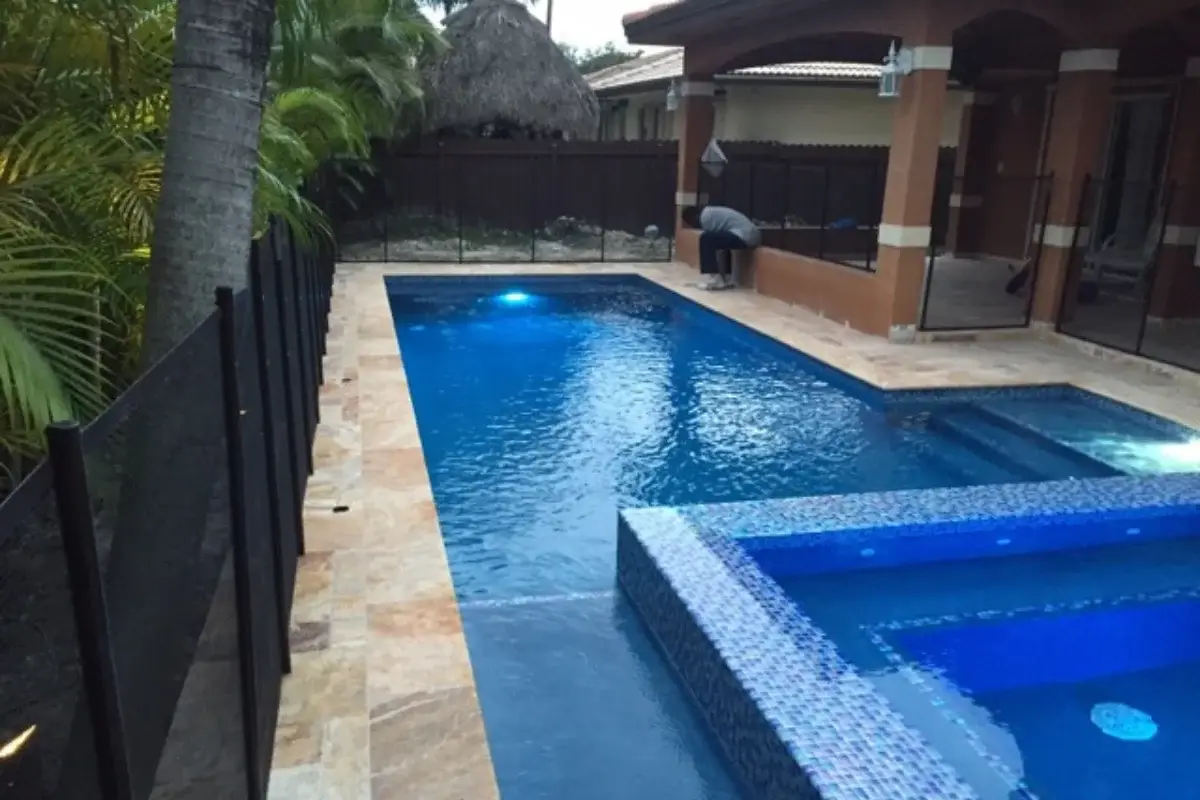
An inground pool needs a protective barrier at least four feet high. Two more rules catch out existing fences:
- No opening in the barrier may allow a 4 inch diameter sphere to pass through
- Every access gate must be self-closing and self-latching, with a locking device
A perfectly good privacy fence often fails the sphere rule at a bottom gap on sloped ground, or at a decorative gate. Far cheaper to catch while we are drawing the plan than while you wait on a final. More on our pool fencing and safety page.
Using the house as part of the barrier
A wall of the dwelling can serve as part of the required barrier, but only if every door onto the pool from that wall has an audible warning device sounding for at least 30 seconds when the door and its screen are opened, or the pool has a power safety cover complying with ASTM F 1346.
The paperwork behind a pool permit in Gwinnett County, and the inspections
Three documents go in together: the building permit application, the Residential Erosion Control and Solid Waste Management Affidavit, and the Residential Swimming Pool Construction Affidavit, filed with the approved location plan and the fee.
We will not publish a fee number here. Gwinnett calculates it as a rate per thousand dollars of estimated construction cost, with a minimum, plus a separate Certificate of Occupancy charge. We confirm current figures with the county on every job.
Then the inspections, in this order:
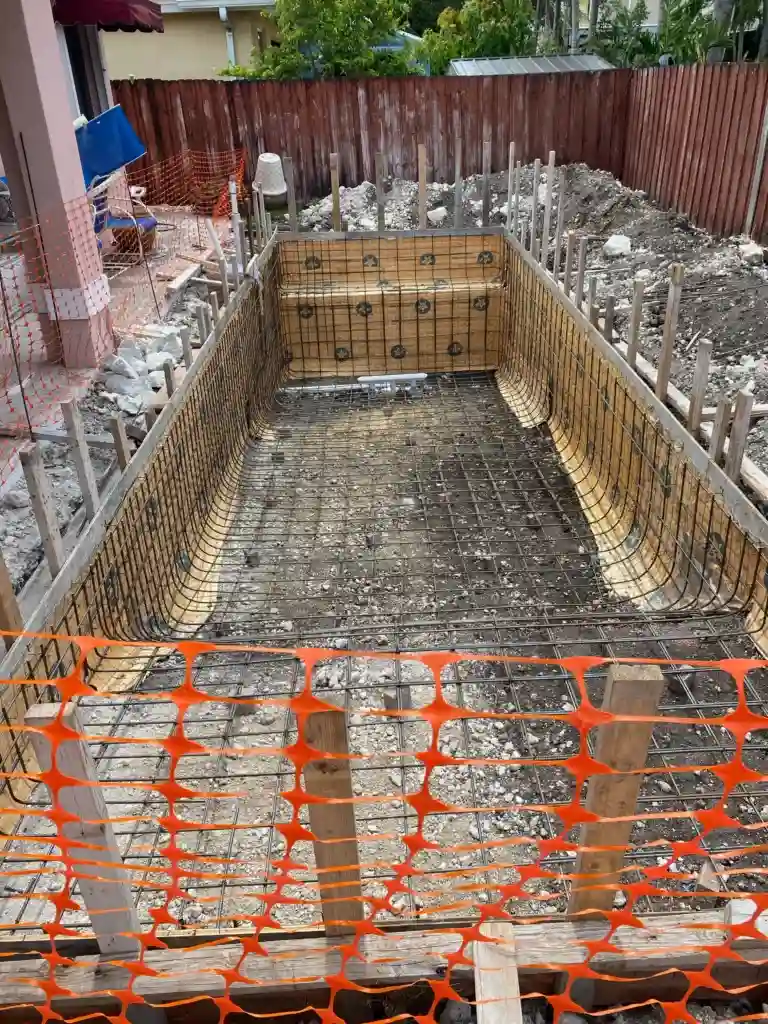
- Site location, erosion and sediment control, temporary protective barriers, and reinforcing steel or basket, which happens before concrete
- Electrical light bonding
- Air test on the pool pump lines
- Electrical rough-in
- Mechanical, if the pool is heated with gas
- Final, covering electrical, structural and mechanical
The permit yard card stays posted visible from the street, and the approved location plan has to be on site when the inspector arrives.
The one thing between a finished pool and a certificate of occupancy
The final inspection specifically verifies that the required barriers and alarms are installed. Only when it passes, with barriers in place, is a Certificate of Occupancy issued and the pool legal to use. So a pool can be finished, filled and genuinely beautiful and still not be legal to swim in because a gate does not latch itself. We schedule fencing before the final, not after.
Barrow County is not Gwinnett
In Winder, Bethlehem and Barrow generally, permits run through Barrow County Planning and Community Development at 30 North Broad Street in Winder, and the county publishes a typical review turnaround of two to three weeks. Auburn is its own case: the City of Auburn publishes a separate residential pool permit packet on top of the county process, so an Auburn address means two sets of paperwork.
Ordinances change, and published requirement sheets go stale. The Gwinnett residential pool requirement sheet still carries a 2012 revision date, which is why we verify with the county before every build instead of trusting a printout. Confirm current requirements with your own county or city before relying on anything written here.
What a permit does not cover: your HOA
County approval and HOA approval are separate, and the HOA usually comes first. Plenty of newer subdivisions across Gwinnett and Barrow have an architectural review committee that wants its own look at the site plan, the fence style and where the equipment pad sits. The county will not check your covenants, and those committees often meet monthly, which makes the HOA the slowest link in many schedules.
How much time the paperwork really adds
Less than most people fear, because it runs alongside the work. Barrow’s two to three week review, the Environmental Health step on septic lots and the HOA meeting date all land while the design is still being finalized. Permitting lives inside the build window, not bolted onto the end of it.
If you want to read the rules yourself
- Gwinnett Development Review Section, Planning and Development, 678.518.6000
- Gwinnett Environmental Health, 770.963.5132, for the septic step
- Barrow County Planning and Community Development, 30 North Broad Street, Winder, 770-307-3000
- City of Auburn, for its own residential pool packet
Common questions
Do I need a permit for a hot tub or spa in Gwinnett County?
Yes, if it holds water more than 24 inches deep. Gwinnett’s residential pool definition names hot tubs and spas directly, alongside inground, aboveground and onground pools.
Can my existing fence count as the pool barrier?
Sometimes. It has to be at least four feet high, no opening may pass a 4 inch diameter sphere, and every gate must be self-closing and self-latching with a locking device. We check the fence at the site visit so any fix is priced in.
Do I pull the permit or does the builder?
We do. We prepare the location plan, pull the subdivision plat, handle the Environmental Health step on septic lots, file the affidavits, and meet every inspection through to the Certificate of Occupancy.
Ready to see it on your actual lot
Every new pool we build starts with a free 3D design you approve before work begins, drawn against your real setbacks, easements and buffers, so what you approve is what the county approves.
Get in touch for your free design and quote, or call (770) 373-8405, Monday through Friday, 8AM to 5PM. We work throughout Gwinnett, Barrow and surrounding counties.
Frequently asked questions
Do I need a permit for a hot tub or spa in Gwinnett County?
Yes, if it holds water more than 24 inches deep. Gwinnett’s residential pool definition names hot tubs and spas directly, alongside inground, aboveground and onground pools.
Can my existing fence count as the pool barrier?
Sometimes. It has to be at least four feet high, no opening may pass a 4 inch diameter sphere, and every gate must be self-closing and self-latching with a locking device. We check the fence at the site visit so any fix is priced in.
Do I pull the permit or does the builder?
We do. We prepare the location plan, pull the subdivision plat, handle the Environmental Health step on septic lots, file the affidavits, and meet every inspection through to the Certificate of Occupancy.